


Amateur Sleuths Outside the Usual Crime-Solving Professions
A baker, a junk removal worker, and a psychic investigator solve mysteries beyond the usual professions.
Police officers, private investigators, lawyers, and forensic specialists have obvious reasons to become involved in a crime. Amateur sleuths need another route in.
Their day jobs do not have to be unusual. Bakers and junk removal workers are ordinary, necessary members of a community. What is unusual is seeing them become crime-solvers—and discovering how the skills of an everyday profession can help them ask the right questions.
That is one of the pleasures of writing the Auntie Clem’s Bakery cozy mysteries, the Bleeding Hearts Valley psychological thrillers, and Reg Rawlins, Psychic Investigator paranormal mystery series. The series all ave very different tones, but both place an outsider to the usual investigative professions at the centre of the mystery.
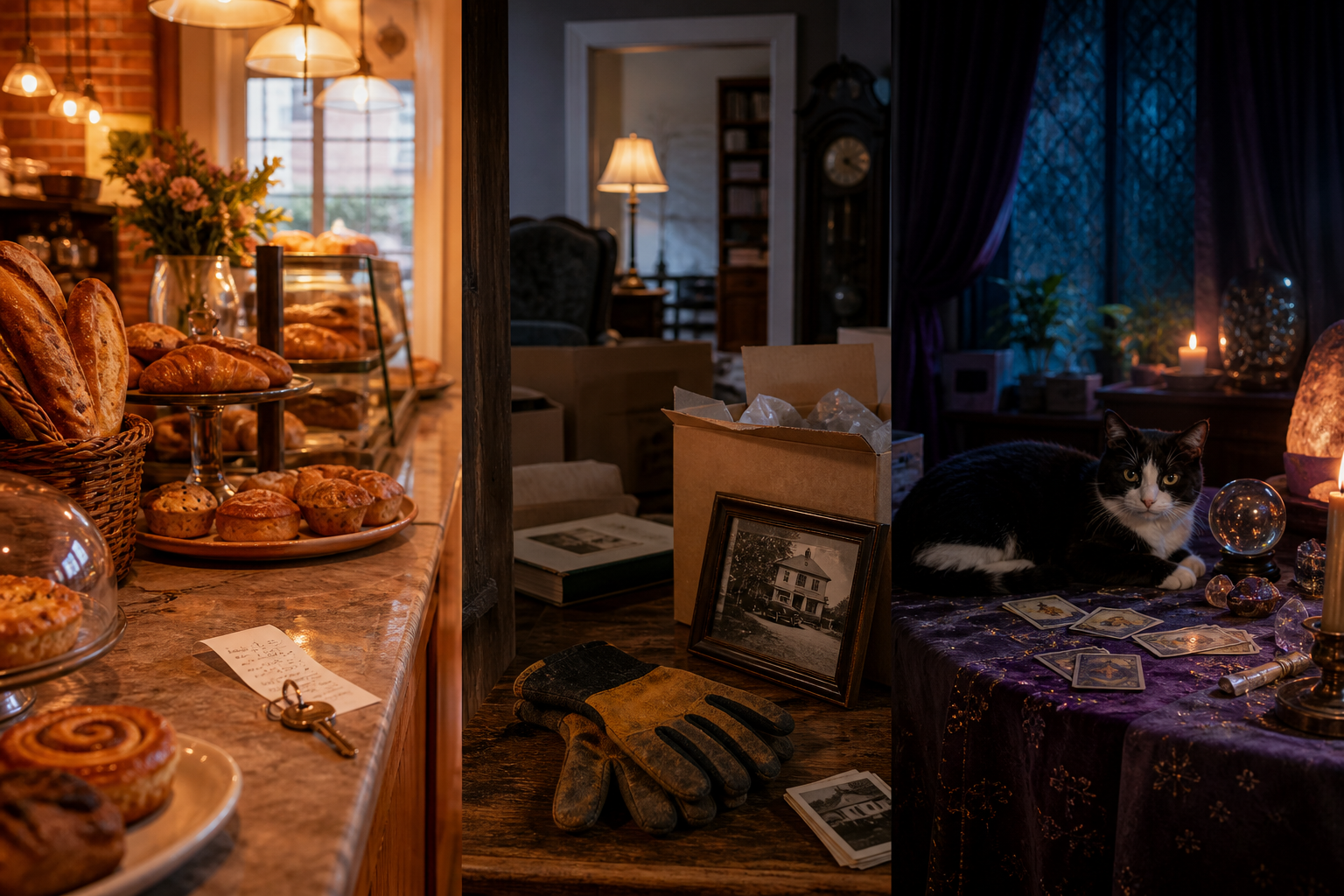
Erin Price: a baker at the centre of her community

There is nothing strange about being a baker. But outside cozy mysteries, it is not a profession commonly associated with solving crimes.
Erin Price’s work at Auntie Clem’s Bakery gives her something an official investigator cannot manufacture: a natural place in the daily life of Bald Eagle Falls. People come in for food, conversation, comfort, and routine. They talk when they are relaxed. They reveal relationships and tensions without realizing how much they have said.
Running a bakery also requires investigative habits. Erin must pay attention to ingredients, timing, substitutions, allergies, and special requests. She knows that a minor detail can matter very much.
Her work does not turn her into a police officer. It gives her a practical body of knowledge and a web of community connections that help her notice when something is wrong.
Graham Hall: a junk removal worker who sees what people leave behind
Graham Hall’s work in Bleeding Hearts Valley gives him a very different kind of access.
He enters homes and other private spaces at moments of disruption. He sees the possessions people have abandoned, hidden, forgotten, or decided they can no longer keep. He has learned to pick the treasures from the trash and to notice when something does not fit.
In An Abrupt Departure and Strike Bag, that experience helps draw Graham into mysteries that are darker and more dangerous than Erin’s investigations.
He is also a very different kind of amateur sleuth. Like Erin, he does not talk much about his past, but unlike the careful baker, Graham has questionable morals. He is not afraid to put pressure on people he believes are bad actors. His instincts may move an investigation forward, but they can also put him in conflict with the people around him—and with the law.
Reg Rawlins: a psychic detective with a con artist’s instincts
Reg Rawlins offers another variation on the outsider sleuth. Her background as a con artist has taught her to read people, improvise quickly, and recognize manipulation. But her life becomes considerably stranger when her psychic abilities prove to be real.
In What the Cat Knew and the mysteries that follow, Reg’s unusual position gives her access to clues other people cannot perceive. But supernatural information does not eliminate the need to understand human motives. If anything, it makes it harder to decide who—and what—to trust.
Why we like amateur sleuths
An amateur sleuth’s occupation shapes the kinds of clues they notice, the people who confide in them, and the risks they are willing to take.
A baker understands food, routines, and the social currents of a small town. A junk removal worker reads rooms through the objects left behind. A psychic with a con artist’s past recognizes both deception and the possibility that something impossible may be true.
These characters do not investigate like trained detectives. That is the point. They approach a mystery through the knowledge they already possess, their access to the community, and they sometimes see what a professional looking through a different lens might miss.
Community gossip
Believable access to the community matters in an amateur sleuth story. A character cannot simply knock on strangers’ doors and expect answers.
A business can create those connections naturally. Customers return. Coworkers hear rumours. Clients need help during stressful transitions. Friends ask favours. People underestimate someone they see as a baker, a cleaner, a shopkeeper, or a hauler of unwanted things.
That web of ordinary relationships gives the sleuth both information and responsibility. They may become involved because the victim was a customer, because a friend is in danger, or because the official explanation does not match what they have seen.
Different professions, different kinds of mystery
The profession is only part of the equation. Tone matters too.
The Auntie Clem’s Bakery books are cozy mysteries built around community, food, friendship, and puzzles. Bleeding Hearts Valley explores troubled histories, moral pressure, and the secrets concealed beneath a respectable neighbourhood. Reg Rawlins blends mystery with the paranormal.
Each series begins with a protagonist outside the usual crime-solving professions. Each asks what that person can see precisely because they are not approaching the problem as a police officer would.
Choose your next amateur sleuth
For a culinary cozy mystery, start the Auntie Clem’s Bakery series.
For a darker psychological thriller, begin Bleeding Hearts Valley with An Abrupt Departure and Strike Bag.
For paranormal mystery and a heroine with a talent for reading people, try What the Cat Knew.
Frequently asked questions
What is an amateur sleuth?
An amateur sleuth investigates a mystery without working as a police officer or professional private investigator. The character may still have specialized knowledge or a job that provides access to useful people and clues.
Are all amateur sleuth mysteries cozy mysteries?
No. Amateur sleuths appear in cozy mysteries, traditional mysteries, psychological thrillers, paranormal mysteries, and other crime-fiction subgenres.
Why give an amateur sleuth a distinctive job?
The job creates a believable route into the mystery and gives the character a particular way of interpreting clues. It can also introduce a setting and community that readers do not usually see in police procedurals.