


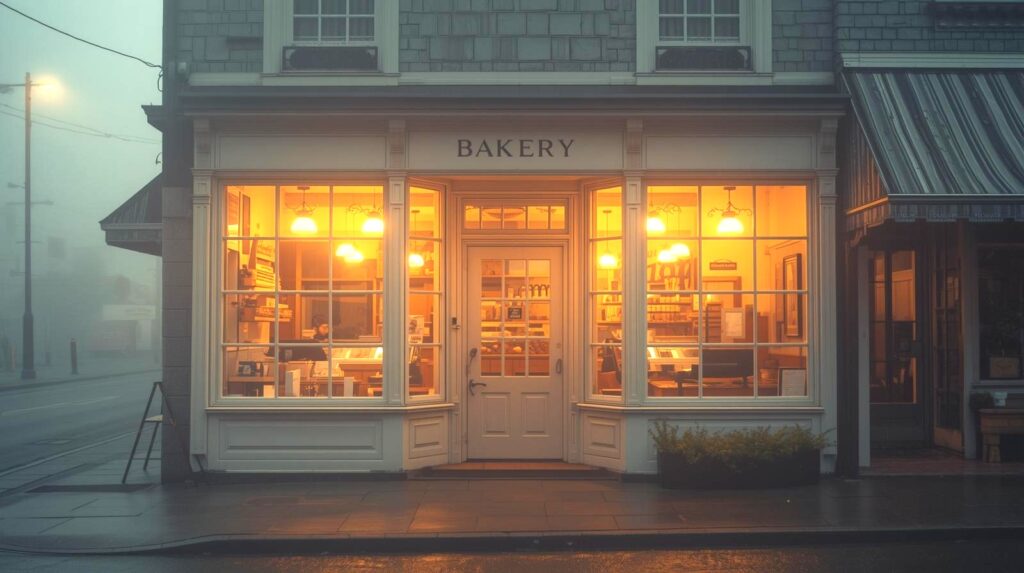
Locked-Room Mysteries in Open Spaces
Crafting Closed-Circle Tension in Small Towns
The “Locked Room” Mystery in Open Spaces
In the world of the Auntie Clem’s Bakery series, you don’t need a remote island or a bolted manor house to create a high-stakes mystery. The small town, insular nature of Bald Eagle Falls serves as a natural “locked room” because the culprit is someone already inside the community.
They are your friends and neighbors, or sometimes an out of town visitor, hiding in plain sight.
What is a “locked circle” in a public place?
A traditional locked-room mystery relies on a physically limited suspect pool—a literal locked room, mansion isolated by a snowstorm, prison, or train.
In a larger setting, social structures—family ties, specialized organizations, or legacy institutions—act as the walls. In Quiche Me Goodbye, the Chickpea Palooza festival is a massive public event, yet the “locked circle” is narrowed to the six specific contestants. The pressure doesn’t come from a physical lock but from the professional rivalries and the limited number of people with the expertise to access specific ingredients or equipment.
Social barriers, family ties, and local institutions
Small-town institutions like church groups or civic clubs operate like locked rooms. Membership, tradition, and reputation are the locks.
In Bald Eagle Falls, the church ladies (like Lottie Sturm and Cindy Prost) and the powerful Jackson and Dyson clans create circles that are difficult for outsiders to penetrate. When a crime occurs within these groups, the suspect list is naturally small and emotionally charged because of generations-old history.
Case study: The Historical Club Poisoning
A perfect example of an open-space locked circle is the mass poisoning in Chocolate Eclairvoyant. The event takes place at a Historical Club meeting in the community center. Because the doors are typically left propped open and the atmosphere is casual, anyone could have walked in, but the logic of the “locked circle” dictates the killer had to be someone who was not out of place in that specific group.
Clues aren’t about picked locks but about local knowledge: who knew the club would be serving Erin’s eclairs, and who had a standing invitation to the multipurpose room?
Using local symbols as evidence
Heraldic marks and family emblems can be as definitive as a fingerprint in a small town. In Chocolate Eclairvoyant, the anonymous “prophecy” letters are written on stationery featuring the Melville Coat of Arms watermark.
To a stranger, this is just paper; to a Bald Eagle Falls resident, it immediately frames Harold Melville, a teenager tied to a legacy family and the Dyson clan. Using such symbols keeps the reader focused on provenance and local heritage rather than random intruders.
Keeping the suspect pool tight
To keep a mystery focused in an open setting, authors lean on these practical mechanics:
- Limit entry points socially: In Quiche Me Goodbye, while the fairgrounds are open, the sabotage focuses on private lockers and specific contestant tents.
- Use alibis rooted in town routines: In Bald Eagle Falls, everyone knows the “baker’s hours”. A suspect’s movements are tracked by caring friends and neighbors and spread by gossip—if you weren’t at the family restaurant or the General Store when you should have been, someone notices.
- Leverage well-known rivalries: Instead of random strangers, use established friction, such as the public arguments between Liam Harper and other foodies or the rivalry between the clans.
Focusing on motive and history over physical locks
In an open-space locked room, the investigation is archaeological. In Dairy-Free Death, Erin realizes the truth is often buried in the past—specifically in Clementine’s genealogy files and journals. Solving the crime means digging through local memory.
As seen at the memorial for Martha Erasmus in Chocolate Eclairvoyant, the members of the community have the entire history of the mountain on the tips of their tongues. The suspect is revealed not by finding a key, but by unearthing the betrayal that looms behind a familiar smile.
Frequently Asked Questions
What is a “locked circle” in an open or public setting?
A “locked circle” narrows suspects by social or institutional boundaries—family ties, club membership, contest entrants—rather than physical locks. It creates the same focused suspect pool as a traditional locked-room mystery but in open spaces.
How can a small town feel like a locked room?
Small towns have built-in barriers: reputation, routine, shared knowledge, and closed social networks. These factors limit who could plausibly commit a crime and who would be “out of place,” keeping the suspect list tight.
What practical mechanics keep the suspect pool small at a public event?
Use social entry points (contestants, club members), private storage (lockers, tents), town routines that track movement, and known rivalries. These elements restrict opportunity and point investigators toward insiders.
How do local symbols and provenance function as evidence?
Family emblems, stationery watermarks, or local heraldry can tie items to specific households or clans. To residents, these marks reveal provenance at a glance and narrow suspicion based on local knowledge.
Should motive or physical evidence be emphasized in open-space locked circles?
Motive and history often matter more than physical locks. Investigations become archaeological: digging through genealogies, grudges, and local memory usually uncovers why someone had motive and access.
How do I keep the story cozy while using these techniques?
Focus on community, character relationships, and believable routines. Let tension come from human histories and small betrayals rather than graphic detail—so the story remains warm and character-driven.